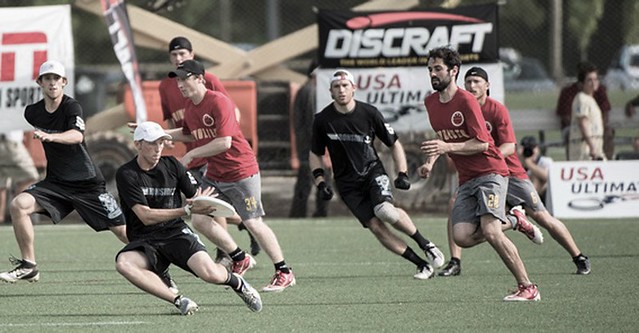
“To excel in ultimate, it’s as much about playing smart as it is your skills. Know your skill limits and play strategically smart within them. Enhancing your skills will create more opportunities.”

There is significant evidence of the advantages of cross-training with other disc sports, demonstrated by the overall disc sports pioneers who also played ultimate frisbee in the 1970s. When Ken Westerfield applied his overall disc skills to ultimate, the potential for cross-training was clear. In this article, Ken explains the advantages of having overall disc skills and how they benefit disc handling skills for today’s ultimate player.
“You can never have too many disc skills for ultimate.”
In the early days of ultimate, there were fewer skilled handlers compared to the number of excellent athletes on the field. Teams were fortunate if they had players with diverse throwing abilities, and even luckier if they had a full field of players who could reliably maintain hyzer upwind with any throw. However, playing skills have developed significantly since then. The articles on this site provide guidance on training for improved throwing power and one-handed catching skills. The training techniques used to enhance skills in other disc sports can also be applied to improve handling abilities in ultimate.
Ultimate Cross-training Handling Exercise
“Adding a throw-and-catch freestyle exercise to your training can improve your ultimate handling skills.”
To enhance and sustain one’s playing skills in any sport, incorporating training activities that emphasize the specific skills required for that sport is beneficial. Elite athletes in any sport often opt for similar sports and exercises for cross-training. For disc athletes, all disc sports have specific disc skills relevant to ultimate and can serve as an exceptional cross-training tool.
It wasn’t common knowledge for players in the early days; they just played all the disc sports. There were clear benefits: disc golf for hucking, pulling, and accuracy, freestyle and double-disc court (DDC) for all handling skills, and guts for one-hand catching and power throwing.
It may be half a century later, but the same benefits of cross-training still apply. Ultimate is fast becoming the breakout disc sport of the future. Although I would never want to see freestyle moves in ultimate, ultimate players should consider the playing benefits that can come from other disc sports, especially freestyle, as an excellent exercise.
A History Lesson
The first organized disc sport was Guts Frisbee, but throw-and-catch freestyle, dating back to the 1950s, was the first activity associated with the Frisbee. In the 1970s, touring freestyle performers demonstrated that the Frisbee was more than just a beach toy. Competitive disc sports, such as ultimate and disc golf, have grown in popularity, but freestyle remains a unique, self-challenging activity that is perfect for developing disc-handling skills.
Fast-Freestyle (Throw and Catch) for Practicing Ultimate Handling Skills
“Freestyle can be a unique training exercise, not necessarily for turning ultimate players into freestylers, but simply as an excellent cross-trainer for improving an ultimate player’s skills for handling the disc.”
When it comes to exercise and training, it’s important to make it enjoyable to achieve the best results. Freestyle isn’t just a game or sport; it’s a set of skills that can enhance your throwing and catching abilities, particularly in situations that require quick throws and one-handed catches. For ultimate players with strong handling skills, freestyle can be a challenging way to improve and maintain those skills. For beginners, it’s a fun way to learn and build confidence. As freestyle throwing is already present in all disc sports, including ultimate, disc athletes should consider incorporating regular freestyle play for handling practice.
Several YouTube videos show freestyle, but most focus on air-bounce throws and nail-delay moves. This isn’t the type of freestyle you are looking for. Eliminating delay aids (plastic nails and silicone sprays) will put you on the right path for a throw-and-catch flow-freestyle as a handling exercise.
Practicing freestyle can be an experimental and playful experience. It doesn’t need to be rigid or structured, making it ideal for warming up or having fun with the disc when not playing ultimate. Incorporating exercises that focus on your disc skills alongside your ultimate play is a great way to improve your handling abilities.
Freestyle Throwing
“Because the current style of playing freestyle focuses on the nail delay move, freestyle doesn’t get the throwing legacy it deserves.”
I’ve seen a few of today’s elite ultimate players produce films of their throwing skills. Rowan McDonnell is a shining example; although he demonstrates a few new variations, most are throws invented and used by early freestylers. They lumped them together as “freestyle throws.” They played a significant role in freestyle before 1975.
Even though you’re highly unlikely to use all these throwing variations in game situations, adding these variations in practice will improve your abilities, especially for beginning and intermediate players. They also help prepare you for adverse conditions like wind, rain, cold, or against a tight defense.
Becoming an offensive threat by utilizing various disc-throwing techniques to attack before the defense can reset is highly effective, as McDonnell has demonstrated in his game. This article encourages incorporating basic freestyle catching into the freestyle throwing techniques showcased by Rowan in his video. It will enhance the variety of your throws and quicken your ability to transition between catching and throwing.
.
Freestyle Catching
Ultimate players might wonder what freestyle catching has to do with two-handed rim and clap catching. Freestyle can help you develop the skill and confidence to catch with one hand.

Two-handed catching mistakenly assumes an offense privilege when it comes to making the catch. Once the disc is in the air, it belongs to no one. Squaring your shoulders for a two-handed clap or rim catch can leave you vulnerable to a block. Players should train to improve their one-handed catching skills.
When running down the ultimate field under a disc about to make a catch, a two-handed rim or clap catch is not always possible or the best idea, especially when a defender is near. To help prevent blocks, always make the first possible contact with the disc by reaching out with the hand that positions your body and the opposite hand between the disc and the defender. This will shut down the diving lane and increase a defender’s risk of a foul.
Freestyle is a one-handed catching practice, catching a spinning disc in any situation. Some primary freestyle catches are behind-the-back, behind-the-head, under one or both legs, forwards, or backward. These catches can also be done while jumping, running, or spinning. When training, adding freestyle catching to the throws you already know is a great way to practice disc catching with one hand on the correct side of the spin in different positions. You can watch early freestyle champion Krae Van Sickle demonstrate a few of these catching techniques.
Krae is demonstrating one-handed freestyle catching skills. Adding freestyle/ultimate throwing variety will make this an excellent ultimate handling training exercise.
Going “Back to the Future”
In the past, players of various disc sports, including freestyle, did not play multiple disc sports for training. Upon reflection, playing these different disc sports did offer valuable training benefits. In the future, ultimate teams will seek every competitive edge, making the freestyle throw-and-catch option an integral part of players’ training to enhance their handling skills.
Players Organizations, and resources: USA Ultimate | Ultimate Canada | PDGA | WFDF | Freestyle Players Association | FrisbeeGuru | Flying Disc Museum | Ultimate Rob
History articles: History of Disc Sports | History of Ultimate Frisbee
© 2025 Disc Sports History. All rights reserved.
 Ultimate Frisbee Handling Skills - Ken Westerfield